

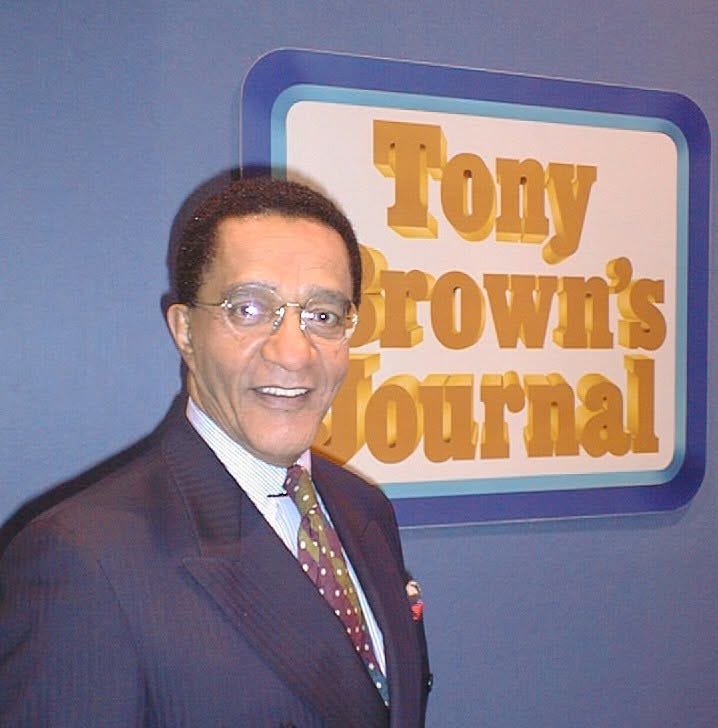
Tony Brown, a groundbreaking journalist, author, educator, and host of the iconic talk show “Tony Brown’s Journal,” has died. He was 93.
He died on June 17 at his home in Newport News, Virginia, of coronary heart disease, according to a statement from his publicist.
“Tony Brown leaves behind a legacy and life defined by education, service, and an unwavering belief in telling the truth. His influence will continue to resonate through the institutions he shaped, the voices he amplified, and the generations he inspired,” the statement read.
“Brown, in the community he called home in his later years, will be remembered not only for what he accomplished, but for the example he set.”
Born in Charleston, West Virginia, in 1933, Brown excelled in athletics and academics at Garnet High School, a historic all-Black school that closed in the 50s after public schools were integrated. Following high school, Brown enlisted in the U.S. Army, where he served from 1953 to 1955.
Brown would later begin studies at Wayne State University in Detroit, where he pursued sociology and psychology and earned his bachelor’s degree in 1959. While in college, he joined the Alpha Upsilon chapter of Alpha Phi Alpha Fraternity, Inc.
Related: Rewatching “Black Journal” Five Decades On by Doreen St. Félix
“However, at that time, I was too young and too immature to ‘realize’ or intellectually absorb the true depths or meaning of the lessons that my ‘7 Jewels’ [Alpha Phi Alpha’s founders] had left for me as a road map to earthly and spiritual elevation,” Brown said in 2014. “They can be roughly summarized as ‘Manly deeds, scholarship and love for all mankind.’”
After his undergraduate studies, Brown was struck by the effects of poverty in Black communities. This pushed him to continue his education by pursuing a master’s degree in Psychiatric Social Work in 1961. He worked as a social worker for a short stint after college.
But journalism was Brown’s true passion. He began working at the now-defunct Detroit Courier as a drama critic in 1963 and rose to become the top editor by 1968.
Brown was also active in the Civil Rights Movement. He helped coordinate Dr. Martin Luther King’s historic march in Detroit in June 1963, in what Brown called “the greatest day of my life.” Dr. King delivered an early version of his iconic “I Have A Dream” speech at this march.
Brown became a household name in the 1970s after he took over as host and producer of the public affairs TV program “Black Journal.” In the late 70s, he received a lucrative sponsorship from Pepsi-Cola, rebranded the series as “Tony Brown’s Journal,” and syndicated it.
The show, which covered Black issues across all topics, was the longest-running national public affairs TV series on PBS. According to its website, “Tony Brown’s Journal” was the “first series on national TV to break the story on the odious Tuskegee Syphilis Experiment on Black men and the infamous Tulsa Race Riot of 1921.”
Figures such as Sammy Davis, Dick Gregory, Richard Pryor, Harry Belafonte, Melba Moore, and others have been featured on the series.
“We have three white viewers for every black viewer,” Brown told the New York Times in 1982. “Even dealing with our subject matter, we've been able to attract whites; you tell the story in its broadest possible aspect - that's mass media.”
“Everything black in this country is just sitting there reserved for me because white people are not interested in it, and many of them are so racist that they believe it doesn't have any worth anyway. I plan to continue to dig into this black gold mine,” he continued.
His show would run until 2008.
A longtime conservative, he preached self-help and remained committed to Black capitalism. “My life’s work continues to focus on encouraging African Americans to develop their economic and intellectual potential,” he once said.
Educating the next generation of journalists was important to Brown. He founded the School of Communications at Howard University in Washington, D.C. in 1971, and served as dean until 1974. He also served as the first dean of the Scripps Howard School of Journalism and Communications at Hampton University in Hampton, Virginia.
There are no plans for a memorial or public service at this time, according to the statement.
What a legacy Tony Brown left on Hampton University students Scripps Howard Journalism students! Sending prayers to his family.
Rest in power