
by McKenna Horsley, Kentucky Lantern

FRANKFORT — The Kentucky General Assembly approved a bill Wednesday to transition the state’s only public historically Black university into a polytechnic institution, after a House committee amended the measure to honor the campus’ legacy.
Republicans and Democrats on the House Appropriations and Revenue Committee unanimously approved a new version of Senate Bill 185, which was unveiled last week after lawmakers had privately discussed the possibility of closing Kentucky State University, particularly in light financial controversies.
The House then voted 90-1 to approve the measure. Rep. Shane Baker, R-Somerset, was the lone nay vote. Hours later, the Senate concurred with the House changes in a vote of 37-0. The bill now goes to Democratic Gov. Andy Beshear for further action.
After the committee adopted the substitute version of the bill Wednesday morning, KSU students and alumni who had packed the meeting room erupted in cheers. Supporters of the university had previously protested the legislation at the Capitol Annex on Friday, as they were concerned it would erode the culture of the university.
Founded in 1885, KSU began in Frankfort as a college to educate Black teachers in Kentucky. It’s one of 19 Black institutions that Congress granted land-grant status in 1890 and still operates a cooperative extension program. In the 1980s, Kentucky added liberal arts to its mission.
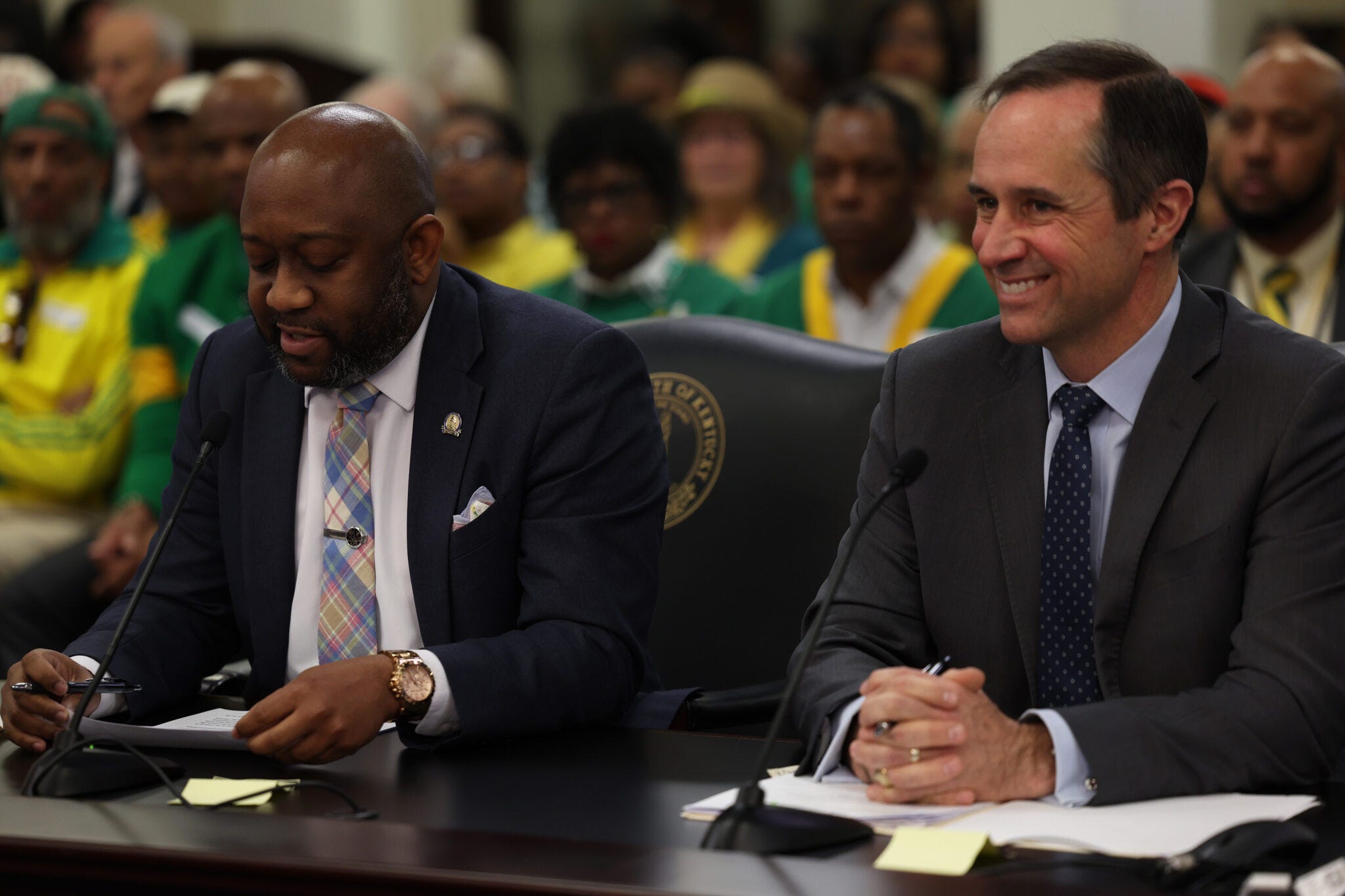
Rep. Joshua Waktins, the House Democratic whip from Louisville, joined the bill’s sponsor, Republican Sen. Chris McDaniel, to present the new version to the House committee. McDaniel said the changes address “many of the concerns that we have heard since the original unveiling.” The Senate approved the bill unanimously last week.
“I fully believe and we fully believe there can be no sustained future for Kentucky State University that does not honor and elevate its historic history,” Watkins said of those who worked on the bill. He added that while the bill would “chart a new path forward” for KSU, “its proud legacy should never be, and is not now, in question.”
Waktins said the changes to the bill included that KSU would focus on “highly technical industry-based applied learning” while offering polytechnic and retaining liberal arts studies that meet Kentucky’s workforce needs. The five-year “state of financial exigency” declared in the original bill could be lifted before the end of that time if the university meets certain criteria and has approval from the Kentucky Council on Postsecondary Education. The Senate bill also required KSU to begin offering no more than 10 academic areas of study.

The bill now also allows fraternities and sororities in good standing on campus to retain their charters. KSU has chapters representing all Divine Nine organizations, or the National Pan-Hellenic Council organizations. The Senate bill would have required all fraternities and sororities on the campus to reapply to the Board of Regents for their charters by July 1.
Watkins told reporters after the meeting that “continued dialog and conversation” is the next step.
“There are still people who have concerns about what this looks like in the implementation, and I think everyday people have that concern about what we do in the General Assembly,” Waktins said. “So, moving forward, there’s going to be greater collaboration between the president and the students, the alumni, the faculty and the staff — all of those relationships need to continue to be strengthened.”
Watkins added that another important relationship will be between the General Assembly, the university and the public as the legislation unfolds over the next five years.
“There’s probably going to be some more tweaking as it goes along, but hopefully the end result is going to be something that everybody can be proud of,” Watkins said.
Toccara Bozeman, a senior at KSU studying nursing, told the Kentucky Lantern after the meeting that with the changes she heard in the committee, she is “content” but still feels like there is more work to do.
Bozeman added that she felt like the legislation was “targeted” at the institution, as other public universities in the state too have high student debts and public safety issues. She also is concerned that liberal arts programs could be jeopardized again in the future.
As reasoning for the bill, lawmakers had previously pointed to a large amount of student debt owed to KSU and incidents affecting campus safety, such as a December shooting where a student was killed and another injured on campus. That had followed a shooting from a car on the campus in August in which two people injured were not students or employees.
Bozeman said having a public historically Black college or university (HBCU) is important for Kentucky.
“There was a time when we were not able to go to school, and my school started off with three teachers and 55 students,” she said, adding that their windows were tinted to hide them from white people who might see them learning.
“That same institution is what enables everyone here today,” Bozeman said.
While voting in favor of the bill, Republican Floor Leader Steven Rudy, of Paducah, said that it is “very important to me that Kentucky State is a success.”
“I believe whole heartedly in this president, his administration, at Kentucky State University is going to turn this institution around and make it the great institution that it once was and can be again,” Rudy said, referring to KSU President Koffi C. Akakpo.
Rudy also thanked McDaniel for introducing the bill, saying that he would likely agree that “the General Assembly fully supports Kentucky State University.”
When the bill came back to the Senate Wednesday afternoon, Democratic Floor Leader Gerald Neal, an alumnus of KSU, urged passage of the bill.
“I am confident that if we invest properly, if we move in good faith, if we make sure that those words moving into a partnership are actualized, if we make good decisions to make this institution stronger and more effective into the future, then what we’re doing here today will be remembered throughout history,” Neal said.
Akakpo wrote in an email to KSU stakeholders after the bill’s passage that it was “a consequential stage in the legislative process for Kentucky State University” following discussions with students, faculty, staff. alumni and more over the past few days.
“As this process moves to the Governor, our focus remains steady,” Akakpo said. “We will continue to advocate for Kentucky State University in a manner that honors who we are, protects what matters most, and positions this institution for long-term strength and sustainability.”