
By Barbara Rodriguez, The 19th News
This story was originally published by The 19th.
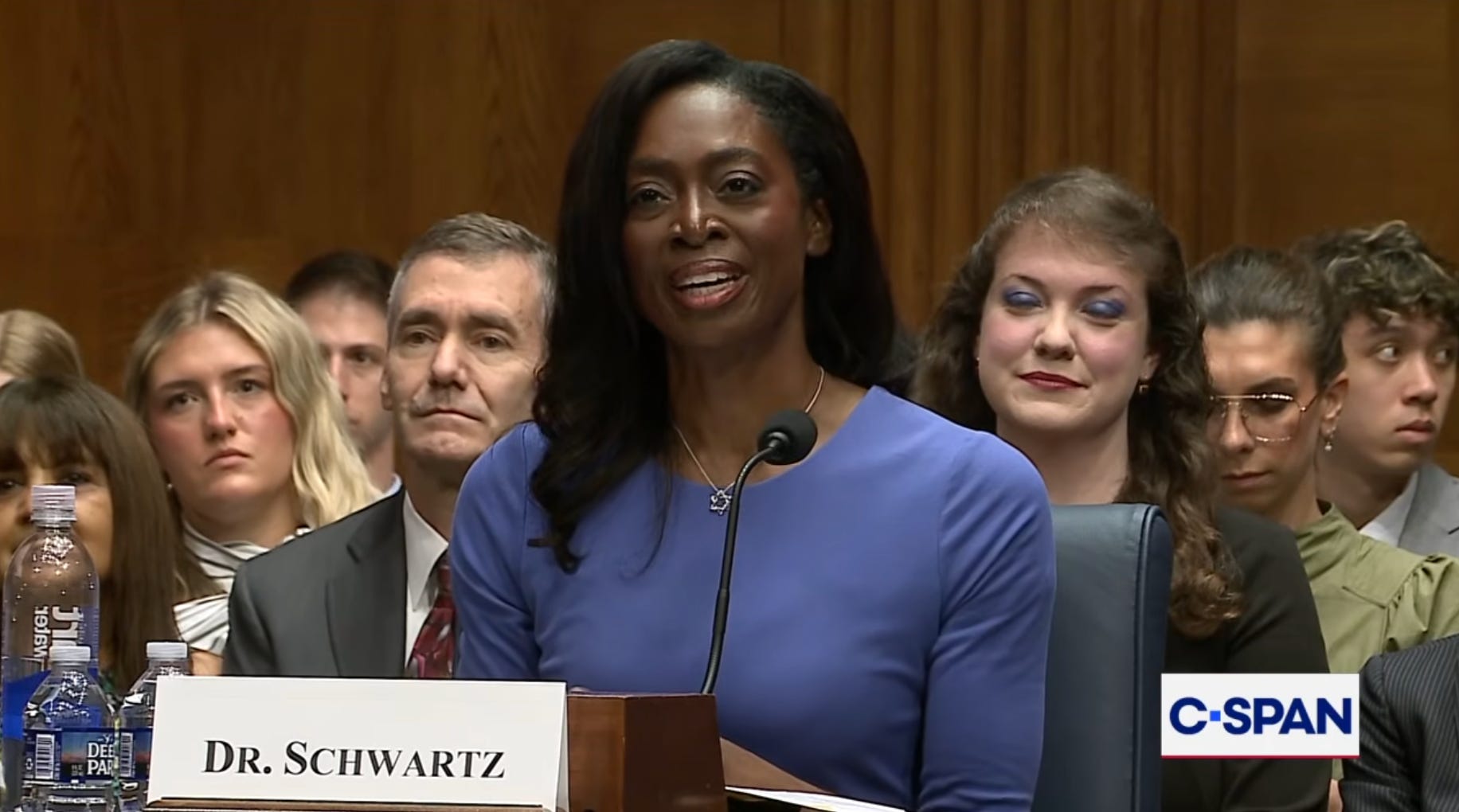
Dr. Erica Schwartz will be the first Black woman to lead the Centers for Disease Control and Prevention, promising that she will show “radical transparency and unwavering scientific integrity” in the role. But she faces political headwinds and practical challenges as she starts the job.
Schwartz, who was confirmed Wednesday by the Senate to run the federal agency that primarily responds to infectious diseases, is expected to balance a public commitment to evidence-based policy and how that might clash with the requests of her new boss, Health and Human Services Secretary Robert F. Kennedy Jr.
A CDC director has typically overseen coordination between the federal government and states during disease outbreaks and other public health emergencies. The job has also entailed approving vaccine policy changes and ensuring accurate health data collection.
But the role has been reshaped under an administration that has questioned trust in government institutions, particularly after a global pandemic that generated right-wing outrage over mask mandates and other COVID-related policies.
President Donald Trump nominated Schwartz — who has served in the U.S. Navy, the U.S. Public Health Service Commissioned Corps and as chief medical officer for the U.S. Coast Guard — but the CDC reports to HHS. Although Schwartz told senators during a July 15 confirmation hearing that she would “follow the science wherever it leads,” she deflected inquiries on whether she would stand up to Kennedy or Trump if she was asked to act in ways that countered scientific evidence.
“She’s trying to walk the tightrope of keeping all of her bonafides: tons of experience, all the background you would want, good relationship with the medical public health community — while also continuing to have the support of the person and people who nominated her,” said Diana Z. O’Brien, a political science professor at Washington University in St. Louis who studies women’s political representation.
Schwartz — who served as deputy surgeon general during Trump’s first term — said neither the president nor the secretary would put her in a problematic position, a response that some senators repeatedly challenged given the firing of Schwartz’s predecessor, Susan Monarez. Monarez said Kennedy, an anti-vaccine activist, terminated her after an August 2025 meeting in which she refused to prematurely approve vaccine policy changes. Kennedy has refuted Monarez’s claim.
Republican Sen. Bill Cassidy of Louisiana, a doctor who was a key vote for Kennedy’s confirmation but has since criticized several of his policy actions, tried to get Schwartz to commit to standing firm.
“We need a CDC director that will actually stand up to crazy, stupid things being said that undermine faith in immunization,” he said. “Are you the person? And I’m being very direct here, because obviously I feel like we’ve got thousands of kids hospitalized because people have promoted that immunization is bad, and now kids have died because of it. It is evil to do that, and people persist. You are the bulwark, so I’m asking: Will you have the ability and the firmness to stand up to that political meddling, to say, ‘No, that’s wrong, and this is right?’”
Schwartz responded: “You have my assurances that I will continue to lead by my integrity. I will never compromise on the science. I will always, always have the public’s health in mind.”
Cassidy later voted to advance Schwartz out of the health committee that he chairs, a key step for her nomination to reach a full Senate vote. Most Senate Democrats on the committee voted down her nomination.
Schwartz is taking over a beleaguered agency battling multiple public health emergencies, including a measles outbreak and climbing cases of cyclosporiasis, a parasitic infection which causes explosive diarrhea. That all comes amid proposed budget cuts to the CDC that have led to staff cuts and weakened some public health programs. Morale among employees is reportedly low, particularly after a deadly shooting at its Atlanta headquarters last year that officials say was driven by misinformation.
Nadia E. Brown is a government professor and director of the Women’s and Gender Studies Program at Georgetown University who studies Black women’s politics. She said Schwartz’s nomination reminds her of the glass cliff theory of organizational leadership — the idea that companies appoint underrepresented leaders at times when they are struggling or facing a crisis. Schwartz brings extensive experience to the job, having served as deputy surgeon general during Trump’s first term and more recently working at UnitedHealth Group along with board roles at several health-related companies. She committed to resigning from those roles if confirmed.
Still, Schwartz is Trump’s third nominee for CDC director. Trump withdrew his first pick, Dr. Dave Weldon, amid reports that senators were critical of his anti-vaccine views. His second nominee, Monarez, was approved by the Senate in July 2025 only to be fired a month later. The agency has not had a permanent leader for nearly a year.
“It’s become a polarized position when it wasn’t,” Brown said. “We know that the country is deeply racialized and gendered, and Black women face misogynoir. And so if she fails, there’s already a built-in trope into why she fails, right? But there’s also an already built-in trope about, ‘Well, try her. What else do we have to lose?’”
There may also be some opportunities for Schwartz. During her confirmation hearing she expressed support for the Make America Healthy Again platform that is credited with elevating Kennedy’s profile and later helping Trump return to the White House. Her public backing of healthy eating and tackling chronic disease could help Trump ahead of a midterm election year that is perceived as having limited policy wins.
But O’Brien said that, too, carries pitfalls.
“Black women have not had the opportunity to be the face of Make America Healthy Again, even though in the abstract we should be prioritizing Black women’s health,” she said. “But they’ve not gotten to be the face of that movement, and she may just face an uphill battle with the core MAHA people, even if she’s able to bolster support among CDC and among the broader polity.”

Schwartz is already facing criticism from some of Kennedy’s staunchest supporters. Aaron Siri, an anti-vaccine activist who has served as a personal attorney for Kennedy, reportedly called Schwartz “the queen of mandating vaccines” — a point highlighted during her hearing when Democratic Sen. Angela Alsobrooks of Maryland asked Schwartz how she would respond to people who do not support vaccine mandates. Schwartz has a history of supporting vaccine mandates for military servicemembers.
“I want to be the CDC director for all Americans. I don’t want to be the CDC director just for Americans that believe in vaccines. I want to be the CDC director for Aaron Siri and people that have concerns about vaccines,” she said.
Almost immediately, Siri responded on social media with a message for Schwartz to “contact my office with proposed dates and we will book a ballroom in DC for a full day ‘open and transparent debate.’”
Schwartz also told lawmakers that mRNA technology — which helped develop COVID-19 vaccines and could address a range of diseases — “is safe and effective.” Kennedy last year canceled federal funding for mRNA vaccine research, claiming the technology poses more risks than benefits for certain respiratory viruses. Public health experts have warned the move could harm the nation’s response to future pandemics.
Brown pointed out that Schwartz as a Black woman needed an impeccable resume — her education includes a medical degree, a master’s degree in public health and a law degree — to even be considered for the job while others in the Trump administration have a history of limited experience for key governmental roles. But those credentials can only get someone so far amid such distrust in science.
“In order to be a Black woman who gets this, she had to come in with an absolutely perfect pedigree,” she said. Normally that would help her, but this is just a very unusual situation where, for the MAHA people, it’s not a good pedigree because it’s too much in the conventional scientific community.”
Adia Wingfield is a sociology professor at Washington University in St. Louis who studies racial and gender inequality in the workplace. She said Schwartz’s goal of restoring trust and bringing transparency faces a high bar in this political climate since public trust in a variety of institutions — Congress, media, universities — is declining.
“Certainly the CDC is not immune from that. So taking on the task of restoring trust to an institution that has been besieged for quite some time is a pretty lofty goal. And that’s not to say that she couldn’t achieve it, but that’s just to say that I think the headwinds are probably against anybody taking on that role,” she said.
The challenge may be exacerbated by Schwarz’s race and gender.
“As a Black woman, I think failing or being unable to achieve those goals in the ways that she has set out would take on additional resonance because of how few Black women have held either that position or tend to hold these types of positions in society at large,” Wingfield said. “It becomes reflective of the group membership, not necessarily of the individual, and that allows for drawing attention away from the bigger structural factors that make it difficult to do the job in the first place.”
Wow! Talk about “twice as good!” MD and JD!!!
This might be the first time TacoDon has nominated someone that is actually qualified for a job.